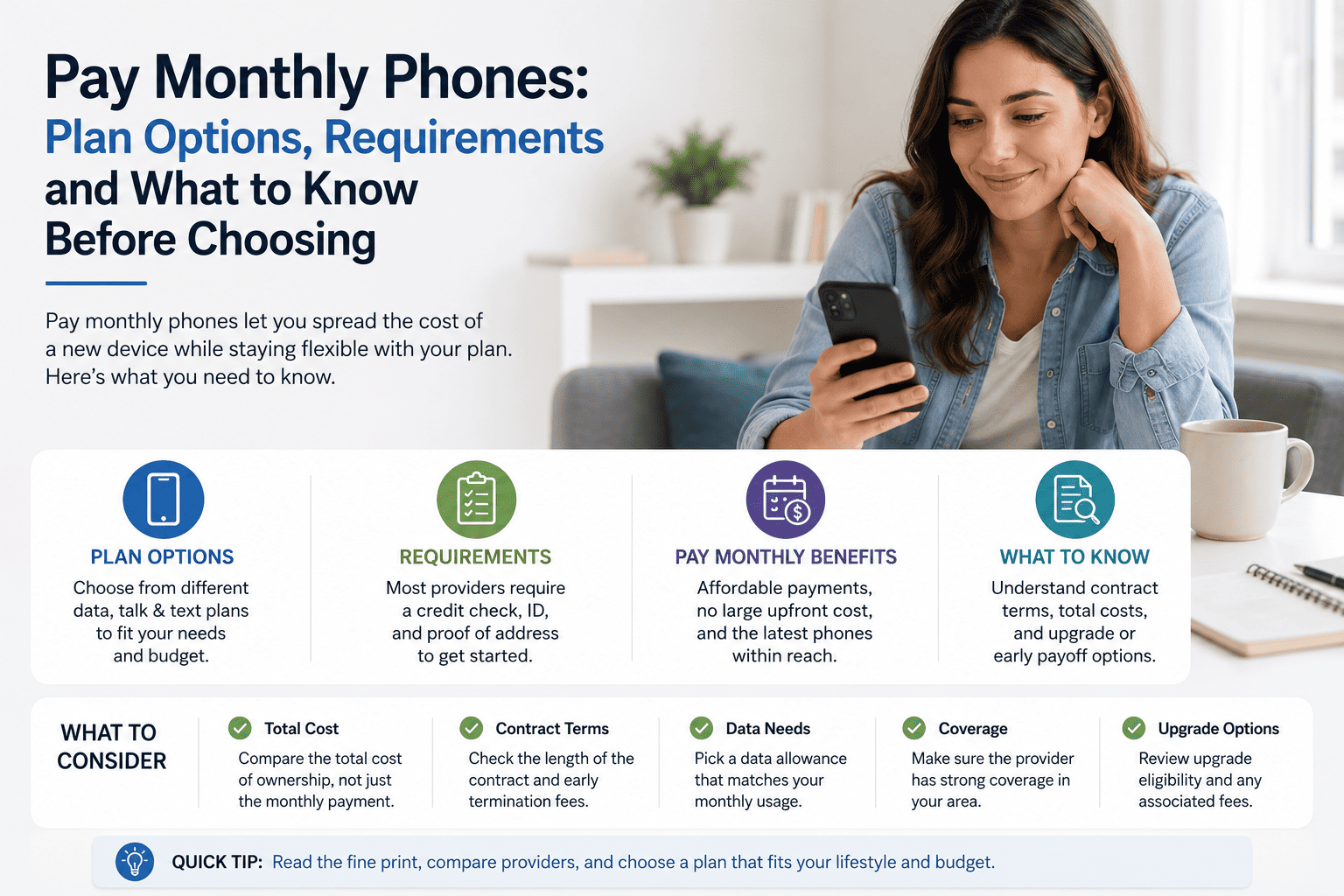
Pay monthly phone plans allow customers to spread the cost of a smartphone and mobile service across recurring payments. This can reduce the amount needed at the beginning, but the advertised monthly figure may not represent the complete cost.
Before choosing a plan, compare the device payment, service charge, contract length, network coverage and any conditions attached to promotional discounts. The most suitable option depends on whether the priority is getting a new phone, lowering the monthly bill, avoiding a credit check or managing several family lines.
How Pay Monthly Phone Plans Work
A pay monthly arrangement may combine two separate expenses:
- The monthly payment for the phone
- The monthly charge for calls, texts and data
Some providers show both charges together on one bill, while others list them separately. Device financing may extend over several years. For example, Verizon currently uses 36 monthly instalments for many devices, while T-Mobile’s financing terms and required down payment can depend on the device and the customer’s credit qualifications.
| Plan option | May suit | Important point to check |
| Phone and service plan | Customers wanting a new device with lower upfront payment | Total device cost and repayment term |
| SIM-only plan | People who already own a compatible phone | Network compatibility and data allowance |
| Prepaid plan | Customers seeking flexibility or fewer credit requirements | Phone may need to be purchased separately |
| Unlimited data plan | Frequent streaming and mobile-data users | Possible speed reductions after heavy usage |
| Family plan | Households managing several lines | Price per line and eligibility for discounts |
| Upgrade plan | Customers who replace phones regularly | Remaining device balance and return conditions |
Credit Checks and Upfront Requirements
Device financing commonly requires credit approval. Depending on the provider, phone and applicant, the customer may qualify for a low down payment, be asked for a larger initial payment or receive a lower financing limit.
People researching pay monthly phones with no credit check should distinguish between service access and handset financing. Prepaid and some lower-cost carrier plans may not require the same credit assessment, but they may also require the customer to bring an existing phone or purchase one separately.
A larger down payment can reduce the monthly device charge. However, buyers should confirm whether taxes, activation charges or the unfinanced portion of the phone are due when the plan begins.
Comparing Data, Coverage and Network Quality
A low monthly price has limited value when coverage is weak in the places where the phone will normally be used. Before selecting a provider, check coverage near home, work and frequently travelled routes.
Major carriers operate their own networks, while Mobile Virtual Network Operators use another company’s network. An MVNO may offer lower-cost plans, although available features, customer support and data priority can differ.
The FCC provides mobile coverage maps that can help consumers compare reported coverage from major providers. Actual indoor reception and local performance may still vary.
People with high data usage should compare unlimited phone plans carefully. “Unlimited” does not always mean every customer receives the same speed under all conditions. Review the provider’s terms for hotspot data, network management and international usage.
Promotions, Trade-Ins and Monthly Bill Credits
Promotions can make an expensive phone appear free or heavily discounted, but the discount may be issued through monthly bill credits rather than as an immediate reduction.
These offers may require:
- A qualifying service plan
- An eligible trade-in phone
- A new line or transferred number
- Continued service for the full promotional period
- An account that remains in good standing
Cancelling service early may stop future promotional credits and make the remaining device balance payable. Both Verizon and T-Mobile state that customers may need to pay the outstanding device amount when service is cancelled.
Buyers exploring phone deals with no down payment should therefore compare the full commitment rather than only the first payment.
What to Compare Before Choosing
Before accepting a pay monthly phone plan, review:
- The complete retail price of the phone
- The number and amount of device payments
- The monthly service-plan charge
- Required upfront taxes or deposits
- Data, hotspot and roaming allowances
- Coverage in important locations
- Activation and upgrade charges
- Conditions attached to promotional credits
- The balance due when cancelling or switching
- Insurance and early-upgrade costs
Households should also compare family phone plans against the cost of maintaining separate individual lines. The lowest total price may depend on the number of users, data requirements and available discounts.
Final Considerations
Pay monthly phones can make newer smartphones more accessible by reducing the upfront payment. However, a lower monthly device charge may come with a longer repayment period, plan requirements or promotional conditions.
The strongest option is not necessarily the phone with the largest advertised discount. Compare the complete device cost, service plan, coverage, credit requirements and cancellation terms before choosing.
Plan availability, financing requirements, promotions and carrier terms may change. Confirm current information directly with the provider before signing up.